
Race is an important conversation to DFM.
We are undergoing an extensive research initiative to discover the lives of the enslaved in Inwood and Upper Manhattan.
Head to our DyckmanDISCOVERED page for more information!
Join the Discussion . . .
One of the most important topics throughout history and today is the topic of race. We at the Dyckman Farmhouse Museum feel that it is important to have and to facilitate conversations on race, even though they can be challenging. Because of this, we have put together a series of talks with experts, each looking at the topic of race from a different perspective. Our hope is that we can all come together, learn from one another, and to continue the conversation.
2026 – Reflecting On America 250
Wednesday, March 18 @ 4:30PM
Lord Help Me Be: Alice Coltrane and the Quest for Freedom in Black Power Era America with Dr. Tammy L. Kernodle
Dr. Tammy Kernodle will explore pianist and harpist Alice Coltrane’s role in pushing forward the avant-garde jazz aesthetic during the years immediately following the death of her husband and collaborator John Coltrane. This lecture examines the symbiotic relationship between the music from her early solo albums and the broader idea of freedom that fueled the rise of the Black Power and Black Nationalist Movements.
Dr. Tammy L. Kernodle is the Park Creative Arts Endowed Professor and University Distinguished Professor of Music at Miami University (OH), where she teaches in the areas of African American music, gender studies in music, and race and American popular culture. She is the author of the biography Soul on Soul: The Life and Music of Mary Lou Williams, a comprehensive examination of the pianist/arranger’s six-decade career. Her scholarship has appeared in various journals, reference books, edited volumes, and anthologies.
Tuesday, March 24 @ 4:30PM
Going to the Territory: History, Memory and the Politics of Place in Beyonce’s Lemonade—10 Years Later with Dr. Daphne A. Brooks
This lecture explores the enduring significance of Beyonce’s pathbreaking 2016 album Lemonade as this year marks the 10th anniversary of its release. Through an examination of New Orleans culture and Lemonade’s (or “this visual album’s) formidable meditations on the afterlives of slavery, Dr. Daphne A. Brooks will showcase the lasting impact of an instant pop music classic and cultural phenomenon.
Daphne A. Brooks is William R. Kenan, Jr. Professor of Black Studies, American Studies, Women’s, Gender, and Sexuality Studies, and Music at Yale University. She is the author of Bodies in Dissent: Spectacular Performances of Race and Freedom, 1850-1910 and Liner Notes for the Revolution: The Intellectual Life of Black Feminist Sound. Her writing has appeared in The New York Times, The Nation, The Guardian, Pitchfork, among others. She is the editor of a forthcoming anthology of essays culled from Blackstar Rising & The Purple Reign: Celebrating the Legacies of David Bowie and Prince, an international 3-day conference and concert which she also curated.
Thursday, August 13 @4:30PM
Anthony and Grietje: New York’s First Couple with Alan Mikhail
This presentation will introduce the seventeenth-century immigrant couple Anthony and Grietje in all their complexity as both outsiders and colonizers. Married in Amsterdam, they crossed the Atlantic to the newly colonized Lenapehoking. Dutch authorities in New Netherland attacked Anthony for being the Muslim he was not, while crude harbor denizens branded Grietje a whore. The rebellious couple was eventually banished to the “frontier,” to what is now Gravesend Brooklyn, where they and their four daughters farmed and seized land from Native Americans while fighting English colonists from the north. Though now mostly forgotten, the rowdy couple’s descendants include some of the most distinguished names in American social and political history, among them the Vanderbilts and President Warren G. Harding.
Alan Mikhail is the Chace Family Professor of History at Yale University. He is the author of six books, most recently Newcomers: The Story of Anthony and Grietje and the Founding of New York. In addition to numerous scholarly articles, he has written for the New York Times, Washington Post, Wall Street Journal, and Los Angeles Times. His work has been translated into over a dozen languages.
Talking About Race Matters 2026 is are made possible by the New York State Council on the Arts with the support of the Office of the Governor and the New York State Legislature. Talking about Race Matters is supported, in part, by public funds from the New York City Department of Cultural Affairs, in partnership with the City Council.
SEPTEMBER 2025 – Afro-Caribbean Identity and History
Tuesday, September 23rd @ 6PM
Genesis of Blackness in the Americas: Santo Domingo, A Passport to Black Caribbean Culture and Identity with Dr. Lissette Acosta Corniel
Genesis of Blackness in the Americas: Santo Domingo, A Passport to Black Caribbean Culture and Identity is a conversation about the first Black people to arrive in the Caribbean and how Santo Domingo (or La Española) played a key role as the main port of entry for the Transatlantic Slave Trade, leading to one of the largest diasporic Black communities and each with a distinct sense of belonging through adaptation, identity preservation, and identity development.
Talking about Race Matters: Join the Conversation September/October 2025 was supported, in part, by public funds from the New York City Department of Cultural Affairs, in partnership with the City Council.
Thursday, September 25th @ 6PM
Living Afro-Latina Lives: An Afrodiasporic Feminist Approach to Understanding Political Consciousness with Dr. Yalidy Matos
Living Afro-Latina Lives: An Afrodiasporic Feminist Approach to Understanding Political Consciousness explores how Afro-Latinas— whether born in the U.S. or abroad but primarily residing in the United States—identify and construct their identities, and how they engage with broader identity categories. Crucially, the work traces the shift from individual identification to the development of an intersectional Afro-Latina political consciousness. This consciousness isn’t just about how they see themselves—it’s about how they act, what they believe, and how they engage politically.
Rooted in Black feminist thought, this intersectional Afro-Latina political consciousness has real consequences for political attitudes and behavior. This works examines how identity becomes action, and how Afro-Latina lives illuminate the power of lived experience in shaping political life.
Talking about Race Matters: Join the Conversation September/October 2025 was supported, in part, by public funds from the New York City Department of Cultural Affairs, in partnership with the City Council.
Wednesday, October 8th @ 6PM
Archival Justice: Black Dominican Studies Archive-Building across Samaná, Puerto Plata, and Ayiti with Dr. Sophia Monegro
Violent silences shape archives. For centuries, memory workers, scholars, and data scientists have worked to repair the archival silencing of our Black past.
Archival Justice: Black Dominican Studies Archive-Building across Samaná, Puerto Plata, and Ayiti introduces restorative justice and community-engaged approaches to building Black archives. You will learn about: We Choose Freedom: Samaná, Dominican Republic, a digital collection documenting the papers of African American descendant Samaneses; the Guerilla Archiving Program currently based in Puerto Plata; and the forthcoming digital archive Cimarronas: A Black Woman’s Archive of Ayiti/Quisqueya, a trilingual platform aimed at making Black women’s histories, as they traveled across the Atlantic, Caribbean, and South America from the 16th to 19th centuries, accessible to diverse audiences using interactive animations, digital mapping tools, primary documents, multimedia essays, and site-based micro documentaries.
Talking about Race Matters: Join the Conversation September/October 2025 was supported, in part, by public funds from the New York City Department of Cultural Affairs, in partnership with the City Council.
FEBRUARY 2025 SERIES – Memorialization and Preservation of Black spaces
Wednesday, February 5th @ 12PM
New Research on Enslavement in Upper Manhattan: A DyckmanDISCOVERED Update
Since 2015, the Dyckman Farmhouse Museum has emphasized the importance of telling a complete history of our site, including the farmhouse’s history as a site of enslavement. In 2023, we hired a research consultant, Ramin Ganeshram, to dive deeper into this history. Ramin searched through archives to continue our research on enslavement, with a primary focus on culinary history, colonial kitchens, and Lenape influences on cooking in the 18th century. In this talk, attendees will hear about the discoveries made during this project.
In addition, attendees will hear from the Dyckman Farmhouse Museum’s Executive Director, Melissa Kiewiet, about how the museum plans to use this research. Melissa will discuss the museum’s reinterpretation plans, beginning with a new exhibition in our basement kitchen that uses Ramin’s new research.
This program is supported by the Ministry of Education, Culture and Science of the Kingdom of the Netherlands, through the DutchCulture USA FUTURE 400 program of the Consulate General of the Netherlands in New York.
Wednesday, February 12th @ 12PM
The Harlem African Burial Ground: History Beneath Our Feet
As a cemetery for free and enslaved Africans from the mid-1600s to the mid-1800s, the Harlem African Burial Ground is a sacred site of New York City’s early history, and yet for decades the site was forgotten and disrespected. Through tireless research and advocacy, community advocates brought this history to light, and now the New York City Economic Development Corporation is leading efforts to properly memorialize and honor the people buried there. Join the Harlem African Burial Ground Initiative and NYCEDC in conversation to learn about this crucial history, the role of urban planning in historic preservation, and the vision for the future memorial, cultural education center, and mixed-use project planned for the site.
Agenda:
- Remarks from Sharon Wilkins, Manhattan Borough Historian Emerita (20 min)
- What is the history of this site?
- How was the site rediscovered?
- What is the importance of memorializing this site? What does it reveal about the city’s history?
- Presentation from EDC (20 min)
- How did EDC’s partnership with the Initiative begin and evolve? How can advocates and government work together?
- What is the role of urban planning in historic preservation and memorialization?
- Moderated Q&A (20 min)
This program is supported by the Ministry of Education, Culture and Science of the Kingdom of the Netherlands, through the DutchCulture USA FUTURE 400 program of the Consulate General of the Netherlands in New York.
Wednesday, February 26th @ 12PM
Envisioning Seneca Village
Seneca Village was a community established by African American landowners in 1825 and destroyed by the City of New York in 1857 for the construction of Central Park. Research beginning in the 1990s has shed light on the once-forgotten village: a stable, successful, rural home to dozens of families. Much is still unknown, however, and no images or above-ground traces remain, making imagining the village challenging. This talk presents Envisioning Seneca Village, an interactive 3D model of what the village might have looked like in 1855. The project’s coauthors will discuss how they combined ongoing research in archaeology, history, historical geographic information systems (GIS), and architectural rendering to build the model; their plans for future improvements; and their aims for the project to both catalyze new research and keep the memory of Seneca Village alive in the present.
This program is supported by the Ministry of Education, Culture and Science of the Kingdom of the Netherlands, through the DutchCulture USA FUTURE 400 program of the Consulate General of the Netherlands in New York.
AUGUST 2024 SERIES – Health and Wellness
Wednesday, August 7th @ 6:30PM
“Bled, Cupped, Blister’d and Purged”—Healthcare in the 18th and Early 19th Centuries
By Dr. Gretchen Sorin
Healthcare in the time of the Dyckman Farmhouse, the 18th and early 19th centuries, was dramatically different from healthcare and wellness today, although we can see vestiges of this time in some current practices. The people of the enlightenment made some moves toward cleanliness, but, the lack of indoor plumbing and body cleansing, the difficulty of finding clean water, and the lack of sewage systems contributed to a host of health problems, as did a limited number of effective medicines. Inspired by an exhibition developed by the Cooperstown Graduate Program, “Health and Hygiene at a 19th century Farmhouse,” this talk will highlight medical practices in this period and the care available to both wealthy landowners and the enslaved people who shared their households.
Wednesday, August 21st @ 12PM
De-Gendered and De-Humanized: The Historical Deconstruction of Black Womanhood
By Dr. Maria DeLongoria
The deconstruction of Black women/womanhood began with negative racial and gendered depictions, while embedded in slavery, flourished with fifteenth and sixteenth century European contact with Africa and the slave trade industry. This presentation focuses on the origin of these historical representations and the legacy that has been created as a result.
Wednesday, August 28th @ 12PM
“I Was their Midwife”: Pregnancy, Childbirth, and Motherhood on Seventeenth-Century Slave Ships
By Dr. Andrea Mosterman
Ships are usually seen as masculine spaces, and slave ships are no exception. But as the slave voyages database shows, about a fourth of the captives transported on board seventeenth and eighteenth-century Dutch slavers were in fact women. In this presentation, I explore the experiences of women on board these slavers, paying special attention to pregnancy, childbirth, and motherhood in these spaces.
FEBRUARY 2024 SERIES – Fashion and Creative Self-Expression
Wednesday, February 14, 2024
Headwraps of African Women in America
Cheyney McKnight
Cheyney McKnight will give a lecture on headwraps found among both free and enslaved African Women in America from the 18th to 19th century. Attendees will learn how headwraps changed from region to region, and the cultural and historical significance of styles.
Wednesday, February 21, 2024
Fashion, Race, Identity, and Power: Black Dandy Beginnings
Monica Miller
This talk will explore the politics of fashion and dress for enslaved and free Black people in 18th and 19th-century Europe and America. Beginning with the phenomenon of dandified “luxury slaves” in 18th-century London, Miller will discuss the way in which the enslaved and free in America used fancy dress and fashion to both visualize freedom and critique contemporary hierarchies of race, gender, class, and sexuality. This talk is based on Miller’s book Slaves to Fashion, a cultural history of Black dandyism, which uses print culture, colonial histories, literature, and theater to tell the Black dandy’s story.
Wednesday, February 28, 2024
Redressing American Fashion: Black Designers in the 19th and 20th Centuries
Elizabeth Way
Black people have always significantly shaped American fashion through their style, their labor, and as innovative fashion makers. From nineteenth-century dressmakers, both enslaved and free, to transitional creatives who helped navigate what an American designer could be, and late-twentieth century designers, embedded in the formal New York industry, Black people have always been a driving force in American fashion.
SEPTEMBER 2022 SERIES – Food and Food Justice
Thursday, September 14, 2022
The Impact of the Age of Exploration on What We Eat
Lavada Nahon
Thursday, September 21, 2022
Food Justice is More than Growing Food and Feeding People
Karen Washington
About the Talk:
For many the idea of decolonizing our lives, includes ‘eating like our ancestors’ but what if you have no idea what your ancestors ate? How far back does one look for those ‘ancestors’? When and how did the world’s foods get so mixed up? In this short program, culinary historian Lavada Nahon will look at the global food and eating exchanges of the 17th and 18th century and their lingering impact on what we eat today.
About the Talk:
People in poor urban and rural communities are told that if they want food security, all they have to do is grow their own vegetables, give up soda and exercise, as if, by magic, eating vegetables and drinking water are going to solve the problems in the food system, without looking at the institutional. environmental and structural determinants that reinforce racism in today’s society. How has the COVID-19 changed the way people now think?
Thursday, September 28, 2022
Here to Stir the Pot: TikTok as a Tool for Elevating Culture & Catalyzing Change
Ora Kemp
About the Talk:
Sprinkle, share, chop, crop, fold and follow; the recipe for a strong social media profile built to catalyze change is like perfecting a recipe. Some content requires a bit of spice, maybe a sweeter delivery, but the flavor needs to stay strong and pronounced, potent in its presentation and uniquely you. Every post is a calculated dose of decolonization, a delectable dissemination of digital decadence and an unfiltered taste of how food is ingrained in cultural traditions. Join us as we serve up social media as the amuse bouche for catalyzing change.
FEBRUARY / MARCH 2022 SERIES
Thursday, February 10th at 6pm
Museums Respond to the Demand for Social Justice: Are We Creating A Sustainable Mash Up?
Ms. Deborah Schwartz
About the Talk:
Some cultural institutions are setting their sights on democracy and social justice. What does it look like in our programming, our governance structures, and our community relationships?
Wednesday, February 16th at 6pm
Courageous Conversations
Mr. Ty Jones and Mr. Michael Dinwiddie
About the Talk:
A moderated discussion centered around the intersection of art and social justice. Seeking to uphold our founding commitment to diversity, equity, and inclusion, our goal is to foster community maintenance through art and conversation.
Wednesday, February 23rd at 6pm
Flow y Movimiento in the Heights: Social Justice & Advocacy in High School
Susan Natacha Gonzalez and Beatriz Oliva
About the Talk:
The daily practice of social justice requires discerning the needs of those we serve. How can organizations assess, and respond to community demands to develop programs and provide support for participants and families? The provision of academic programs, non-traditional social-emotional and mental health services within the academic setting will be explored.
Wednesday, March 2nd at 6pm
The American Plate: Race, Place, Taste and the Future of Food Equity
Ms. Ora Kemp
About the Talk:
Sowed from seeds of fertile grounds, sweat drenched brows and broken backs, the flavors of the American plate are seasoned with slavery’s bitterness. Salted with segregation and smoked in stacks of racial injustice, the hunger pangs that linger in the gut of black and brown folks has fully grown into an insatiable desire for change.

This program is hosted in partnership with The Classical Theatre of Harlem.



This program is supported, in part, by public funds from the New York City Department of Cultural Affairs in partnership with the City Council, the Honorable Ydanis Rodriguez, New York City Council, District 10, and the Manhattan Borough President’s Office. Additional funding is provided by TD Bank.
AUGUST / SEPTEMBER 2021 SERIES
Wednesday, August 25th at 6pm
Bedtime Stories about Slavery and the Legacy it Left on this Nation
Mr. Joseph McGill
About the Talk:
What started as an attempt to bring much needed attention to extant slave dwellings, has evolved into a movement to change narratives at historic sites throughout the nation.
Wednesday, September 1st at 6pm
I Was Here: Reshaping the American Commemorative Landscape
Marjorie Guyon, Marshall Fields, Patrick J. Mitchell, Dr. Michael Preacely, Michael Baer, and Barry Darnell Burton
About the Talk:
Created by photographing contemporary African Americans as archetypal Ancestor Spirits, the Portraits invoke the Human Family – Man, Woman, Child, Mother, Father, Sister, Brother.
Wednesday, September 8th at 6pm
Markers on the Land: Slavery, Commemoration and the History of Africans in Northern Manhattan
Dr. Robert W. Snyder, Peggy King Jorde, Dr. Andrea Mosterman, and Richard Tomczak
About the Talk:
With changes contemplated for an African burial ground and Native American ritual site in Inwood, join us for a panel discussion on the history of slavery at Dyckman House, in New Amsterdam, and in the early years of the United States. How might we best study this past and commemorate it in the present?
Wednesday, September 22nd at 6pm
“Troubled Like the Restless Sea”: Frederick Douglass and the “Profusion of Luxury” in Early America
Dr. R. Ruthie Dibble and Dr. Tiffany Momon
About the Talk:
Over 150 years after the publication of My Bondage and My Freedom, Frederick Douglass’s rhetorical genius still offers new insights into American art and history. Co-curators Drs. Ruthie Dibble and Tiffany Momon illuminate how a passage from Douglass’s autobiography became the basis of a collaborative curatorial intervention at the Milwaukee Art Museum that explores the troubled status of luxury goods in early America.
Wednesday, September 15th at 6pm
‘A Long Time Coming’: The Archaeology and History of the Native and African American Community in Setauket, NY
Dr. Christopher Matthews
About the Talk:
This presentation will discuss recent archaeology and community-based research focused on the mixed-heritage Native American and African American community in Setauket, on Long Island, NY. The talk will explore this history of this community, highlighting their long struggle to persist despite consistent and intensifying racism and displacement.


This program is made possible by funding from the Bowery Residents’ Committee and The New York Community Trust.
FEBRUARY / MARCH 2021 SERIES
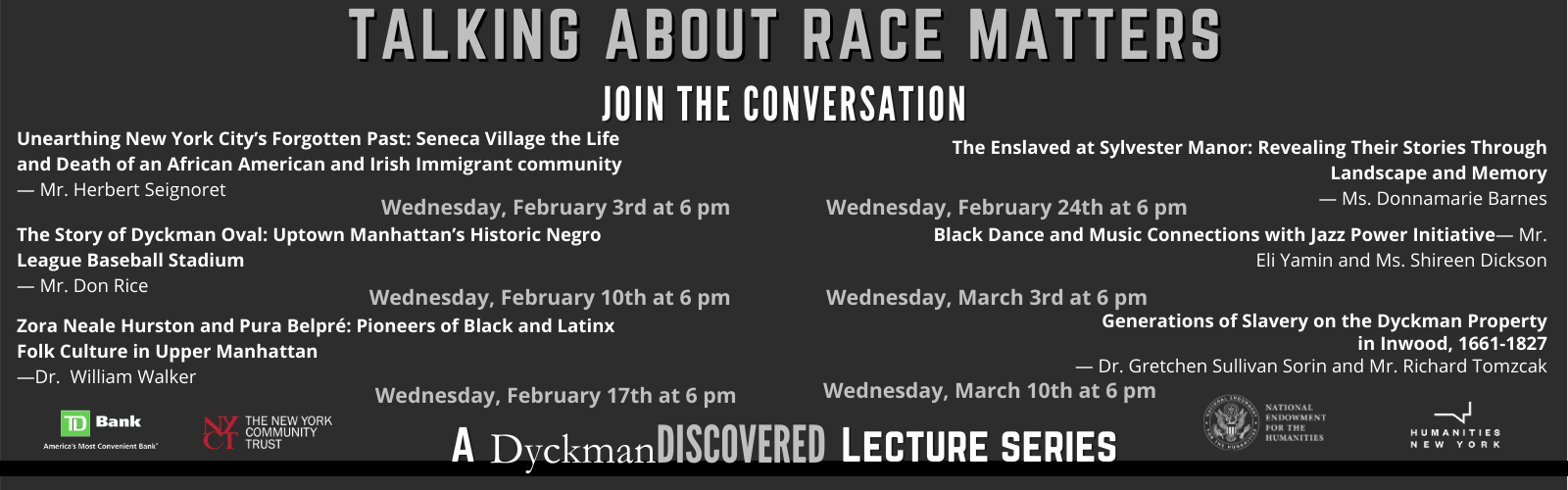
Follow the link to watch on Crowdcast or watch below on YouTube: https://www.crowdcast.io/e/unearthing-seneca-village
Unearthing New York City’s Forgotten Past: Seneca Village the Life and Death of an African American and Irish Immigrant Community
Mr. Herbert Seignoret
About the Talk:
Seneca Village was established in the 1820s as a free Black settlement. The Institute for the Exploration of Seneca Village History (IESVH) has defined its boundaries as 82nd to 89th Streets and 7th to 8th (Central Park West) Avenues, as these streets might extend into the park.
CLICK for Herbert Seignoret’s Select Bibliography and Additional Resources
Follow the link to watch on Crowdcast or watch below on YouTube: https://www.crowdcast.io/e/dyckman-oval
The Story of Dyckman Oval: Uptown Manhattan’s Historic Negro League Baseball Stadium
Mr. Don Rice
About the Talk:
When the legendary Dyckman Oval ballpark opened at the northern tip of Manhattan in 1917, Major League baseball was still decades away from including players of color. Black independent teams at the time were filled with fantastic players, and NYC sports fans wanted to see these teams play. But for years local stadium owners had blocked many of them from booking games here.
Click here for Don Rice’s resource list to learn more about the Dyckman Oval.
Follow the link to watch on Crowdcast or watch below on YouTube: https://www.crowdcast.io/e/zora-neale-hurston-and
Zora Neale Hurston and Pura Belpré: Pioneers of Black and Latinx Folk Culture in Upper Manhattan
Dr. Will Walker
About the Talk:
In January 1932, at the John Golden Theater on 58th St. between Broadway and 7th Ave., the famed writer Zora Neale Hurston mounted a daring and innovative revue called The Great Day, which featured Black folk culture in all its splendor.
Follow the link to watch on Crowdcast or watch below on YouTube: https://www.crowdcast.io/e/sylvester-manor
The Enslaved at Sylvester Manor: Revealing their stories through Landscape and Memory
Ms. Donnamarie Barnes
About the Talk:
Sylvester Manor on Shelter Island, the ancestral home of the Manhansett People, began in 1651 as a provisioning plantation worked by enslaved Africans brought from Barbados. For almost 400 years, the place has descended through the same family.
Follow the link to watch on Crowdcast or watch below on YouTube: https://www.crowdcast.io/e/harlem-jazz-and-dance
Black Dance and Music Connections with Jazz Power Initiative
Mr. Eli Yamin and Ms. Shireen Dickson
About the Talk:
How did the uptown spirit of community collaboration translate into worldwide recognition of black American artistic excellence? Join dancer Shireen Dickson and musician Eli Yamin for this experiential and participatory blend of facts, video footage, and signature songs and dances from the swing and bebop eras…
Follow the link to watch on Crowdcast or watch below on YouTube: https://www.crowdcast.io/e/slavery-on-the-dyckman
Generations of Slavery on the Dyckman Property in Inwood, 1661-1827
Dr. Gretchen Sullivan Sorin and Mr. Richard Tomczak
About the Talk:
The generations of enslaved people that worked for the Dyckman family experienced ever-changing legal codes that restricted their movement, behaviors, and well-being. From the Dutch “half-freedom” of Jan Dyckman’s New Amsterdam, to the “negotiated manumission” of New York State, the family and their slaves were at the center of unfolding chapters of American history.
This program is sponsored by TD Bank.
This program is made possible by funding
from the New York Community Trust.
AUGUST 2020 SERIES
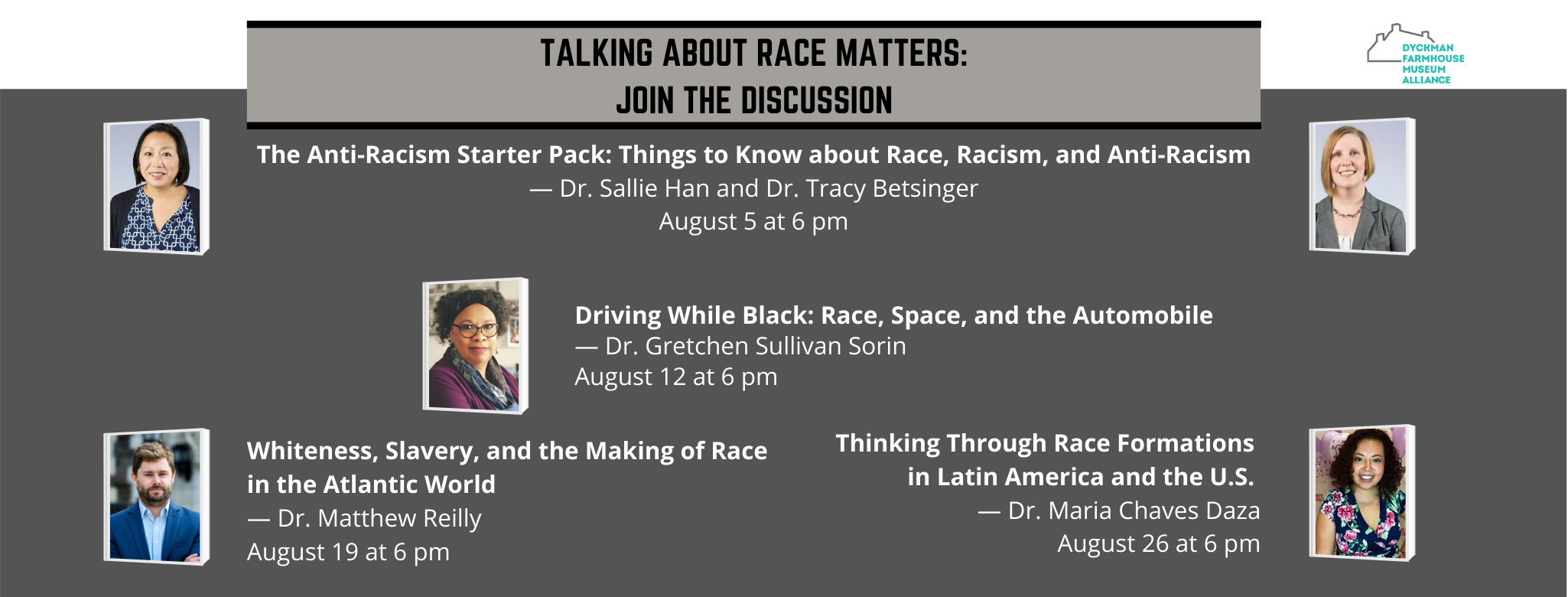
Watch on YouTube or follow the link to watch on Crowdcast: https://www.crowdcast.io/e/the-anti-racism-starter
The Anti-Racism Starter Pack: 5 Things to Know about Race, Racism, and Anti-Racism
Dr. Sallie Han and Dr. Tracy Betsinger
About the Talk:
In this presentation, we will discuss what is known from the anthropological sciences about race and racism. Our hope is that when we are ourselves better informed, we can help educate and guide others as well as fight back and call out ignorance and misinformation.
Watch on YouTube or follow the link to watch on Crowdcast: https://www.crowdcast.io/e/driving-while-black-race
Driving While Black: Race, Space, and the Automobile
Dr. Gretchen Sullivan Sorin
About the Talk:
It’s hardly a secret that mobility has always been limited, if not impossible, for African Americans. Before the Civil War, masters confined their slaves to their property, while free black people found themselves regularly stopped, questioned, and even kidnapped.
Watch on YouTube or follow the link to watch on Crowdcast: https://https://www.crowdcast.io/e/whiteness-slavery-and
Whiteness, Slavery, and the Making of Race in the Atlantic World
Dr. Matthew Reilly
About the Talk:
By the seventeenth century, England was establishing its empire throughout the Americas. In addition to implementing processes of land dispossession, Indigenous genocide, and large-scale agricultural production, this period also marked the rise of…
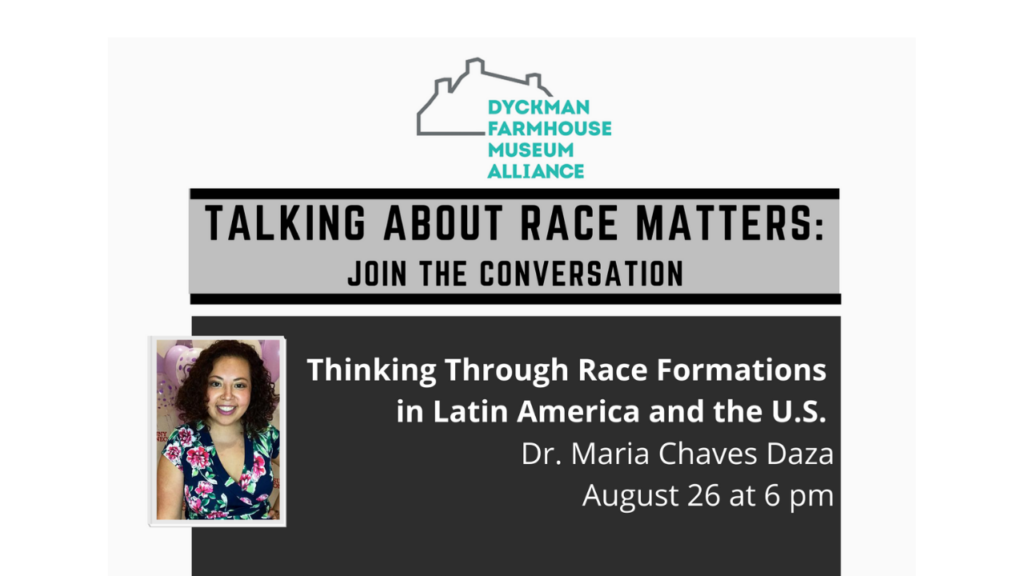
Follow the link to watch:
https://www.crowdcast.io/e/thinking-through-race
Thinking Through Race Formations in Latin America and the U.S.
Dr. Maria Chaves Daza
About the Talk:
While race impacts all communities, race is not the same all over the world. This talk will provide and introduction to how race formations differ in Latin America, including Spanish speaking Caribbean, and the U.S.
CHECK OUT OUR NEW MERCH!
Support the Dyckman Farmhouse Museum by purchasing a limited edition design that highlights the enslaved and free people who lived and worked at the Farmhouse.
Proceeds support further research and educational programming on the topic of the enslaved and free people highlighted on the products.
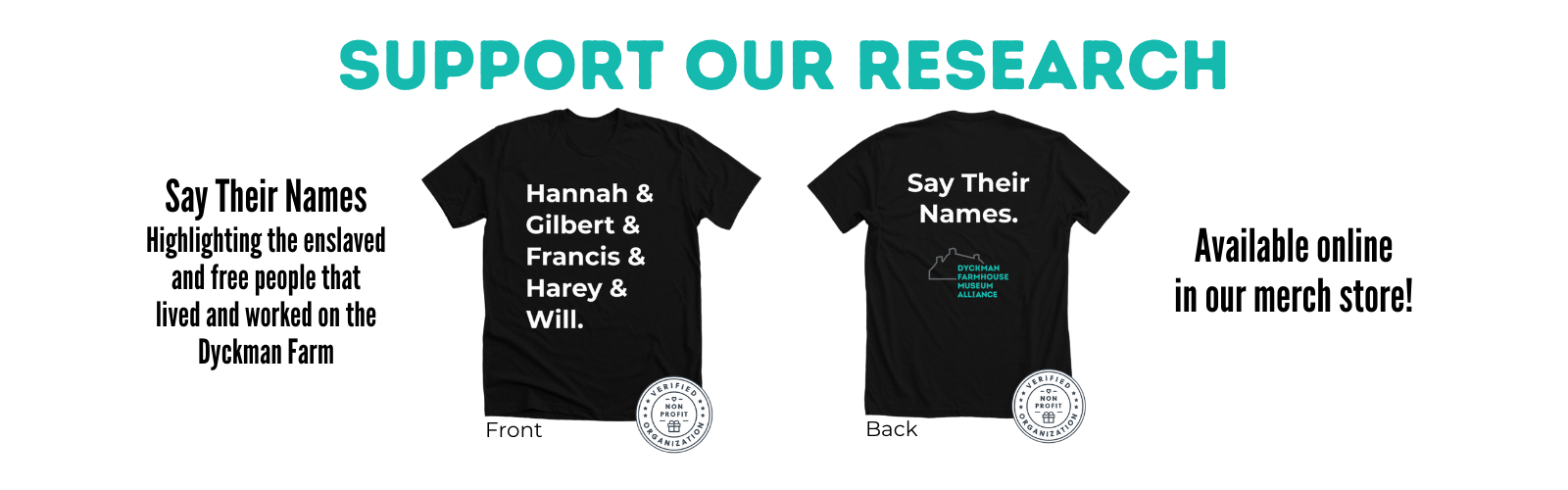
Make a purchase today to help us support DFM research and free public programming!
Dyckman Farmhouse Museum is funded in part by a Humanities New York CARES Grant with support from the National Endowment for the Humanities and the federal CARES Act. Any views, findings, conclusions or recommendations expressed in this program do not necessarily represent those of the National Endowment for the Humanities.